 admin
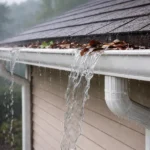
Overflowing gutters are often associated with thick layers of leaves, twigs, and visible debris. However, a gutter system can appear relatively clean and still struggle to handle rainwater effectively.
When water spills over the edges instead of flowing through the downspouts, the problem may involve hidden blockages, improper gutter positioning, or drainage issues that are not immediately noticeable.
Understanding these less obvious causes can help homeowners identify problems earlier, protect their property’s exterior, and make better maintenance decisions.
1. Hidden Blockages Inside Downspouts
A gutter channel may look clear from the ground, but that does not guarantee water can travel through the entire drainage system.
Leaves, small branches, roof granules, and other debris can accumulate inside downspout elbows or narrow sections. These obstructions restrict water movement and may cause gutters to overflow during rainfall.
One indication of a blockage is water spilling from the gutter while little water exits the downspout.
Homeowners can observe drainage behavior from a safe location during rainfall. If a blockage is suspected, a qualified professional can inspect and clear the affected section without risking an unsafe ladder climb.
2. Gutters That Have Lost Their Proper Slope
Gutters need a slight downward slope toward their outlets to transport rainwater efficiently.
Over time, loose fasteners, shifting brackets, or accumulated weight can affect their alignment. Even a small low spot can allow water to collect instead of moving toward the downspout.
Standing water may also encourage sediment buildup and create additional pressure on the gutter supports.
Signs of improper alignment include:
- Water remaining in gutters after rainfall
- Overflow concentrated in one section
- Visible sagging along the roofline
- Water collecting away from downspout openings
Correcting the slope may involve adjusting hangers, securing loose sections, or replacing damaged components. Proper alignment helps the existing system work as intended.
3. Debris That Accumulates Between Cleaning Sessions
Even recently cleaned gutters can develop drainage problems when nearby trees continually shed leaves, seeds, needles, or small branches.
Some debris collects around outlet openings rather than spreading evenly across the gutter. This makes blockages difficult to identify from the ground.
Homes surrounded by mature trees may require more frequent inspections than properties with limited overhead vegetation.
For homeowners dealing with recurring debris, gutter guards installation can be one option worth evaluating alongside regular cleaning and downspout maintenance.
Gutter guards are designed to limit the amount of larger debris entering the system, but their effectiveness depends on the design, surrounding vegetation, roof conditions, and installation quality.
They also do not eliminate maintenance entirely. Fine particles can still accumulate, and guard surfaces may require periodic cleaning.
The goal should be to choose a maintenance approach that suits the property rather than assuming one solution works for every home.
4. Gutters That Cannot Handle Roof Runoff
Not every overflow problem is caused by a blockage.
During intense rainfall, a gutter system may receive more water than it can efficiently transport. This can become particularly noticeable where large roof sections direct runoff into a relatively short gutter.
Roof shape, drainage area, gutter dimensions, and the number of downspouts all influence performance.
For example, a roof valley can concentrate runoff into one location, creating a heavy flow of water during storms.
If overflow repeatedly occurs during intense rainfall despite clean gutters and functioning outlets, homeowners may need a professional assessment of the system’s capacity.
Possible improvements include adjusting outlet locations, evaluating gutter dimensions, or adding downspout capacity where appropriate.
5. Loose Gutters and Damaged Fasteners
A gutter system depends on secure attachment to the roofline.
When brackets loosen or fastening points deteriorate, sections may pull away from the fascia board. This can create gaps that allow rainwater to escape behind the gutter instead of entering the channel.
The issue may become more noticeable during storms, when water volume increases.
Homeowners should look for visible separation between gutters and fascia boards, uneven sections, or water running down exterior walls.
Damaged wood around attachment points also deserves attention. Simply tightening a fastener may not provide a lasting repair if the underlying support material has deteriorated.
Addressing loose sections early can help prevent additional damage to nearby exterior components.
6. Problems Where the Roof Meets the Gutter
The area where roofing materials meet the gutter is essential for directing runoff into the drainage channel.
If the drip edge is missing, damaged, or incorrectly positioned, water may travel behind the gutter rather than flowing into it.
This problem can resemble ordinary gutter overflow, especially when water drips from behind the system during rainfall.
Over time, repeated moisture exposure can affect fascia boards and nearby exterior finishes.
Homeowners may notice peeling paint, discoloration, or damp areas beneath the roofline.
A proper inspection should examine the relationship between the roofing edge, drip edge, fascia, and gutter placement. Correcting these components can improve drainage without necessarily replacing the entire gutter system.
7. Downspouts That Discharge Water Too Close to the House
Sometimes gutters are functioning correctly, but the drainage system still creates problems at ground level.
A downspout that releases water directly beside the foundation can contribute to soil saturation, erosion, or unwanted moisture around the home.
Poor grading can make the situation worse by allowing discharged water to flow back toward the building.
Homeowners should observe where water travels after leaving each downspout.
Extensions, properly designed drainage outlets, or landscape grading improvements may help move runoff away from vulnerable areas.
However, drainage changes should account for neighboring properties, local requirements, and the overall landscape. Redirecting water without considering its destination can create new problems elsewhere.
Conclusion
Gutter overflow is not always a simple cleaning issue. Hidden downspout obstructions, incorrect slopes, damaged fasteners, roof-edge problems, and inadequate drainage capacity can all contribute to water escaping the system.
The most useful approach is to identify where the water flow is being interrupted before deciding on a repair or upgrade.
Regular inspections, appropriate debris management, and timely maintenance can help homeowners keep rainwater moving away from vulnerable exterior surfaces. When problems persist, a professional drainage assessment can reveal issues that are difficult to identify through a visual inspection alone.